Though Prog Is Alive and Well in the 21st Century, I have decided to go back and "fill in" the years upon which the 21st Century is built, and not just the "classic" years of 1967-76. Each year will be given its own page, containing reviews of the albums I determine are worthy of recognition (both positive and negative). As usual, these pages will be works in progress, to which I'll be adding information as it comes my way.
My Favorite Albums of 1997:
1. STEREOLAB Dots and Loops
2. ALAIN ESKANAZI/BRAINSCAPES Chakradancer
3. PAT METHENY Imaginary Day
4. PÄR LINDH PROJECT Mundus Incompertus
2. ALAIN ESKANAZI/BRAINSCAPES Chakradancer
3. PAT METHENY Imaginary Day
4. PÄR LINDH PROJECT Mundus Incompertus
5. HÖYRY-KONE Huono Parturi
6. MONO Formica Blues
7. BJÖRK Homogenic
8. VOLARÉ Uncertainty Principle
9. RADIOHEAD OK Computer
10. THE FLOWER KINGS Stardust We Are
8. VOLARÉ Uncertainty Principle
9. RADIOHEAD OK Computer
10. THE FLOWER KINGS Stardust We Are
11. THE GATHERING Nighttime Birds
12. ART ZOYD Häxan
13. IN THE WOODS Omnio
16. AFTER CRYING 612. ART ZOYD Häxan
13. IN THE WOODS Omnio
14. DISCIPLINE Unfolded Like Staircase
15. FATES WARNING A Pleasant Shade of Gray17. SINKADUS Aurum Nostrum
18. OZRIC TENTACLES Curious Corn
18. OZRIC TENTACLES Curious Corn
19. SYMPHONY X The Divine Wings of Tragedy
20. DJAM KARET The Devouring
Honorable Mentions:
DAVID CROSS Exiles
BONDAGE FRUIT III - Récit
ROBERT WYATT Shleep
Five Star Prog Masterpieces
(Ratings of 100 to 93.34)
None
The "Minor" Masterpieces
(Ratings of 93.33 to 90.0)

1. HÖYRY-KONE Huono Parturi
Possessed by both the craziness and virtuosic genius of both King Crimson and Frank Zappa, this Finnish band provided the 1990s with two superb albums of heavy chamber prog. I agree with other reviewers that this album, the band's second, is better than their debut because it is less dark and, more, because it shows a more polished, better engineered version of their virtuosic skills as composers and musicians.
Line-up / Musicians:
- Tuomas Hänninen / guitar
- Jussi Kärkkäinen / guitar
- Topi Lehtipuu / violin, vocals
- Marko Manninen / cello
- Jarno Sarkula / basses, flute, backing vocals
- Teemu Hänninen / drums
With:
- Peter Nordins / drums (4,8)
- Pasi Kiiski / performer (5)
- Patrik Latvala / performer (5)
- Jussi Kärkkäinen / guitar
- Topi Lehtipuu / violin, vocals
- Marko Manninen / cello
- Jarno Sarkula / basses, flute, backing vocals
- Teemu Hänninen / drums
With:
- Peter Nordins / drums (4,8)
- Pasi Kiiski / performer (5)
- Patrik Latvala / performer (5)
- Robert Löflund / performer (5)
1. "Beata Viscera" (6:53) opens with low drone and lone mediæval monk Topi Lehtipuu singing in Latin. Amazing! In the third minute the low-end drone is doubled (tripled) by other instruments as the vocalist continues with increased passion. Things soften again at 3:45 until 5:30 when Topi stops and the drones and overtone-chanting takes over. (15/15)
2. "Terva-Antti Ku Häihin Lähti" (4:02) like King Crimson and Frank Zappa at their craziest and most polished and complex--only performed with chamber instruments alongside the rock electric one. (9.5/10)
3. "Karhunkaato" (4:21) this one opens with more of a heavy prog feel/sound but then takes a 222 degree turn left and oblique into Romany or Slavic rock opera. (9/10)
4. "Lumisaha" (4:39) lots of hand and stick-hit percussives (makes me think of P-We YOSHIMI's tribal rhythms on her OOIOO project's albums). The whispered vocals also remind me of OOIOO, but the operatic vocalise in the background and heavy, odd-tempoed Crimson-like foundational music say otherwise (more like Zeuhl bands RUINS or UNIT WAIL). Topi's vocals come full operatic (á la That Joe Payne) before the song reaches its finish. (9/10)
5. "Baksteri" (1:57) a kind of carnival-public orchestral interlude with a horn/winds quartet. (4.5/5)
6. "Huono Parturi" (4:52) abrasive, angular notes and chords open this one before cello takes over with drums, bass, and saw-like guitar accompanying. A switch as Topi enters with a very dramatic cabaret-like voice. I feel as if I'm watching an outdoor performance of some Punch and Judy puppet show on a side-street of some old bricked road in an old mediæval inner city of a European city. Not my favorite; more repetitive than most other H-K songs. (8.5/10)
7. "Ullakon Lelut" (2:19) pipe organ sounding arpeggi opens before cello and then volume-controlled electric guitar and hand drums join in. Very cool and unusual sound palette. (4.5/5)
8. "Tottele" (2:39) pure feedback/special Fx noises opens this before a 70s Red-era King Crimson groove and palette take over. Could verily have come out of the Red sessions. (10/10)
9. "Kala" (5:11) opens with a spy-detective film soundtrack feel, which only gets amplified and enhanced as the full band joins in. When it comes time to add vocals, Topi and background vocalists put together an awesome weave against a much more sparsely filled foundation. Strings interlude after the second verse and brief return to KC heaviness then turns mystical/angelic as Topi performs some beautiful wordless vocalise within the chamber weave of bass, drums, electric guitar, cello, and, gradually, multiple other harmonizing vocals. Weird but awesome song! (9.75/10)
10. "Laahustaja" (6:21) opens like an old rocker from 1970 before electric guitar is joined by drums and cello. More virtuosic twists and turns of heaviness and light are performed on this song's interesting journey. Flute paired with heavily distorted guitar and power chords is very interesting. A few too many turns on this one ust got me lost, or bored. Vocals could have helped.(8.75/10)
11. "Laina-Ajalla" (5:27) cello and violin support Topi as he heads back into monastic operatica. (I am very much reminded of That Joe Payne.) Acoustic and electric guitars join the weave in the second minute as do drums and bass. The chamber weave is awesome--very ANEKDOTEN-like (which is purely a coincidence since Anekdoten drummer Peter Nordins was sitting in on a couple of songs on this album). It's so difficult rating this songs as they are so unlike any that I've ever heard before in my life. (9.5/10)
Total Time: 46:24
93.33 on the Fishscales = A/five stars; a full-out masterpiece of ingenious and refreshing progressive rock music from a group of very creative and virtuosic Finns. I agree with other reviewers that this album, the band's second, is better than their debut because it is less dark and, more, because it shows a more polished, more virtuosic display of composition and musicianship.

2. PÄR LINDH PROJECT Mundus Incompertus
Line-up / Musicians:
- Magdalena Hagberg / vocals
- Jocke Ramsell / electric & acoustic guitars
- Pär Lindh / piano, harpsichord, church organ, Hammond organs, Mellotrons, synths, percussion, 12-string guitar, producer
- Marcus Jäderholm / bass
- Nisse Bielfield / drums, percussion
With:
- Singillatim Choir / chorus vocals
- Jonas Bengtsson / recorder
- Inge Thorsson / violin
- Michael Axelsson / oboe
- Aron Lind / trombone
1. "Baroque Impression No. 1" (9:10) heavier and rockin' more than most of previous album's music. (19/20)
2. "The Crimson Shield" (6:38) a "baroque-folk" piece with harpsichord and Mellotron supporting the gorgeous vocal of Magdalena Hagberg. Reminiscent of Anthony Phillips' The Geese and the Ghost. (9.5/10)
3. "Mundus Incompertus" (26:43) one my Top 15 long-playing prog epics of the 1990s. (45.5/50)
Total Time: 42:34
93.125 on the Fishscales = A/five stars; a masterpiece of progressive rock music and a veritable masterpiece of the Neo Prog movement.

3. STEREOLAB Dots and Loops
The metamorphosis and maturation of Stereolab is complete! The vocal weaves! The acoustic guitar strums! The drumming and sophisticated rhythm constructs! The flamboyant bass play! The horns! The Motown rhythm guitar play! And they've even constructed two epic length songs! And, of course, the ever-present Farfisa and social-political messages of Lætitia Sadler.
1. "Brakhage" (5:13) a clear demonstration of the maturization that has occured within the band's compositions, production, and levels of instrumental mastery. (9/10)
2. "Miss Modular" (4:29) it's like four or five songs going on in one--all at the same time: quirky keyboard offerings, funky groove from the rhythm section, catchy acoustic guitar strum-fest, funky-futuristc horn arrangement, and then two separate vocal lines! Amazing! (10/10)
3. "The Flower Called Nowhere" (4:55) the spacey opening turns full-French soundtrack before strumming acoustic guitars and Farfisa keys bounce together with the drums and gorgeous, sophisticated multi-layered vocals permeate this masterpiece. (10/10)
4. "Diagonals" (5:15) a bit of a trip hoppy, acid jazz sound and beat open this one as horns and xylophone add to the rhythm track. The bass almost feels on its own!--until the rhythm guitars/Farfisa come in. Lætitia enters, singing in French, before Mary's multivoiced background vocals work into the weave with their own lyrics accenting and off-setting those of Ms. Sadler. Brilliant construct if lacking a bit of accessibility due to the sophistication of the weave, low-engaging melodies, and lyrics in a foreign language. (8.75/10)
5. "Prisoner of Mars" (4:03) Tom-tom play, percussives, sustained organ chords, and wonderful bass line provide the foundation for Lætitia to sing two of the most gorgeous melody lines in the Stereolab repertoire--the first in English, the second in French. Amazing! Brilliant! (10/10)
6. "Rainbo Conversation" (4:46) probably the most accessible, catchiest earworm of a song on this album full of catchy, brain-haunting melodies and rhythms. Even has a section for impassioned instrumentals and some amazing drumming! (10/10) As proggy of a song as you can get … until …
7. "Refractions in the Plastic Pulse" (17:32) like a slow stroll through an endless French park: Versailles, Bois de Bologne, Fontainbleau, Chambord, Les Vosges--take your pick--it's gorgeous, peaceful, soul-recharging.
The first shift occurs at 3:28 when everything tightens up and is slowly squeezed down a drain until it comes out the other side at 4:35 as an upbeat trip-hoppy jaunt--perhaps on a horse or in an ATV. The lyric remains the same, just speeded up and embellished with other layers differently.
In the eighth minute a radio-telegraph-sounding high trail of sound enters while the other tracks fade away, leaving a very spacey display of heavily effected synth burbble-waves to provide the new foundation for Lætitia and Mary's wonderful weaves--now clear, front and center from the former and murky-background from the latter (still in French. Gorgeous!). The synth play is very Pink Floyd/Richard Wright-ish.
At the end of the twelfth minute we enter another transitional passage in which some very electro-computer-pop percussive noises are generated and sequenced for the new foundation. Berlin School (TD, Klause Schulze)-like down to the synth sounds chosen to carry the new chord sequence.
At 14:15, full bass n drums rhythm section enters and violin-like synth in the lead while Farfisa bounces slowly from measure to measure, chord to chord, while L & M rejoin, returning to their original lyric in a slowed down, violin-mirrored, medium-paced fashion to the song's end. This final section is my favorite. (31/35)
8. "Parsec" (5:34) a straight on TripHop jam that sounds like it came straight off of EVERYTHING BUT THE GIRL's Walking Wounded. Awesome! (9.25/10)
9. "Ticker-Tape of the Unconscious" (4:46) a very cool, very French soundtrack sounding groove in which the lyrics of the lead vocal are tucked within the music by a muting effect--this while the supporting "background vocal" track is clear, open, and in the fore! Ingenious! (9.5/10)
10. "Contronatura" (9:04) another Frenchified acid jazz sounding construct over which both Mary and Lætitia sing their separate tracks in dreamy/sexy voices. Great bass play that must have been an inspiration for Norwegian duo KOOP. From 4:00 to 5:40 the rhythm tracks drop away leaving only the squirts and spurts from the computer keyboard, but then the song recommences with a totally pop-rock groove and smoothed out paired vocal track--all the while the computer keyboard continues to spit out all kinds of sounds in line with the "this is the future" lyric the girls are singing. Brilliant! (18/20)
The key difference from the previous year's excellent Emperor Tomato Ketchup and this offering is the band's mastery of disciplined multi-layering--both in vocals and in their foundational instrumental/sound weaves.

4. PAT METHENY GROUP Imaginary Day (1997)
Five star songs: My favorite song on the album and one of my all-time favorite Pat Metheny songs, the Scottish-infused, 9. "The Awakening" (9:39) (20/20); 1. "Imaginary Day" (10:11) odd but effective mixing of SE Asian sounds with some pretty raw and raunchy guitars (17.75/20); 2. "Follow Me" (5:56) this one grabs you right from it's start with the multiple layers of melodies and riffs but these catchy riffs occur and recur throughout (10/10); 3. "Into the Dream" (2:28) harkens back to earlier Pat Metheny stuff (New Chautauqua and the song, "As Falls Wichita, So Falls Wichita Falls") It's beautiful (5/5), and; the techno-contemporary (for 1997), trip-hoppy blended with minimalist (and Grammy Award winning), 7. "Roots of Coincidence" (7:48) (13.5/15).
Four songs: the more straightforward jazz song--with some awesome muted trumpet play, 4. "A Story Within the Story" (8:01) (8.5/10); the Spanish flamenco feeling epic with some of my favorite Lyle piano passages and percussion work from the support staff, 5. "The Heat of the Day" (9:24) (17.75/20); one of Pat's requisite soft emotive guitar-based pieces (with some nice orchestral support--which I live--á la Secret Story), 6. "Across the Sky" (5:03) (8.75/10), and; the other, more acoustic, requisite Pat solo guitar-based soft-jazz piece, 8. "Too Soon Tomorrow" (5:51). Very emotional and beautifully arranged. (8.5/10).
91.46 on the Fishscales = A-/five stars; a minor masterpiece of progressive rock music and one of the best jazz fusion albums of the 1990s. Consistent high quality and extraordinary musicianship.
91.46 on the Fishscales = A-/five stars; a minor masterpiece of progressive rock music and one of the best jazz fusion albums of the 1990s. Consistent high quality and extraordinary musicianship.

5. IN THE WOODS... Omnio (1997)
A surprise find for me as I found myself actually liking this music quite a bit. Strong vocals (male and female) and entertaining double lead guitars over competent metal compositions led me to reminders of 70s stallwarts, Black Sabbath, Thin Lizzy, Blue Öyster Cult, and Peter Hammill. Also, I was not expecting chamber strings to be so effective in the two long epics.
- Jan Kennet Transeth ("Ovl Svithjod") / vocals
- Christian "X" Botteri / guitar
- Bjørn Harstad / guitar
- Oddvar "A:M" Moi / guitar
- Christoffer Michael "C M" Botteri / bass
- Anders Kobro / drums
With:
- Christian "X" Botteri / guitar
- Bjørn Harstad / guitar
- Oddvar "A:M" Moi / guitar
- Christoffer Michael "C M" Botteri / bass
- Anders Kobro / drums
With:
- Arve Lømsland / keyboards (4)
- The Dust Quartet / violins, viola & cello (1,5-7)
1. "299 796 km/s" (14:46) one of the best long-playing prog epics of the 1990s! (28.5/30)
2. "I Am Your Flesh" (7:07) Cool composition with heavy and light/spacious sections alternating throughout. Great lead guitar work in the B parts. The vocals are engineered a bit oddly (as if from the 1970s). As a matter of fact, it's the vocal parts that are, for me, the weak part of this song, otherwise, I love this song. (13.25/15)
3. "Kairos!" (3:34) muted & echoed electric guitar arpeggi stand alone for the first 40 seconds of this one. Then a burst of heavy chords and slow drum and bass establishes itself as the structure over which a female vocalist sings. Great song, great vocal! (9.25/10)
4. "Weeping Willow" (11:40) sustained buzzing lead guitar notes are slowly faded in and then joined by second cleaner guitar and keys. At 1:17 a guitar riff establishes the foundation for the rest of the song. Multiple voices enter, with one low male voice taking center fore. Piano joins in, too. Then, at 2:40 comes a drastic switch to a more steady driving motif with fast-strumming electric guitars using only their low end strings. The pace is still not very fast and the vocal more deep and ominous and slow--not unlike some PETER HAMMILL vocals (and thus the lyrics are very clear). Back to the slower pace for a bit before switching back to hard-driving mode at the 5:20 mark for some instrumental action. At 6:20 vocals return but multiple guitars are still soloing (albeit, slowly). At 6:50 slow guitar arpeggi take over as dominant under structure for the singing to continue in his low, slow PETER HAMMILL voice. More guitar soloing in the ninth and tenth minutes. Even as the song slows and winds down in the final 90 seconds, the two guitars continue to play off of one another. (18/20)
- "Omnio?" (45/50)
5. "Pre" (12:00) highlighted by the two main catchy guitar riffs (a little ROBIN TROWER like!) and the contrast of the deep male voice with the operatic soprano female. Cool! (23/25)
6. "Bardo" (5:55) heavy use of synths (who's playing?) and STEVE HILLAGE-like space guitar until Pink Floyd-like bass and drums enters halfway through and space synths (guitars?) start going bat crazy. Culminates with scream and crescendo of sound. (9/10)
7. "Post" (8:09) opens with piano and bass before dropping away into a "Great Gig in the Sky" accompaniment to Synne Larsen's impassioned-though-worded vocal. Piano and female voice exit in 20th minute as thick multi-guitar weave takes over. AT 20:30 multi-tracks of Jan Kennet's low voice enter. This is awesome! In the 22nd minute, the pace changes, the voice shifts to upper octave power vocal. An alternation with the slower, female-led section occurs twice before we return to "Great Gig" theme, only with electric guitar and Jan Kennet performing the music over the slow, steady rock drum track. Nice, plaintive vocal. Then things re-amp for the final 90 seconds. (13/15)
Total Time: 63:11
91.20 on the Fishscales = A-/five stars; a minor masterpiece of progressive rock music and one of the better Prog Metal albums I've heard from the 1990s.
Total Time: 63:11
91.20 on the Fishscales = A-/five stars; a minor masterpiece of progressive rock music and one of the better Prog Metal albums I've heard from the 1990s.

Just because the band came from the same country as prog revivalists Änglagård and the fact that they chose to play complex compositions of woven folk-oriented tapestries using somewhat anachronistic palettes of instruments it doesn't mean they're copycats. There is a far greater number of "classic era" prog bands that could be listed as influencers to Sinkadus' music than just their Swedish countrymates.
- Rickard Bistrom / bass, vocals, guitar
- Fredrik Karlsson / keyboards
- Mats Svensson / drums
- Lena Petterson / cello
- Robert Sjoback / guitars
- Linda Johansson / flute, vocals
1. "Snålblåst" (18:33) after three minutes of beautiful flute-led pastoral opening, the music condenses a bit as Rickard Bistrom's chunky bass prompts the band to take on heavier, more Yes-like territory. From here there seems to be a back-and-forth battle for supremacy, at first drawn out but then sped up into literally every few seconds: dense and heavy countered with soft and pastoral. Near-classical organ and guitars make themselves known in some nice variations to the "war," while Linda Johansson's flute continues to lead the expedition. Rickard and Linda then enter with harmonized vocals, further cementing the near-classical, folk-pastoral approach the band is trying for. The song and moods being forwarded throughout, I have to admit, are more upbeat and mischievous--as if the band is trying to tell a Narnia-like folk story with plenty of playful, ambiguous Grimmsian tongue-in-cheek absurdity and irony. The music never becomes overly bombastic or pedantic, always seems to be seeking pleasant entertainment. The song is so cleverly constructed and rendered that one cannot help but marvel and want to listen to it again. Immediately! Not only is this a masterpiece of beautifully-texturized audience-duping entertainment it is way more accessible than anything done by the band to whom Sinkadus is always compared. This is more like if early Genesis had Mike Oldfield, Michael Dunford of Renaissance, and Kerry Minnear contributing to their compositions. (37.6667/40)
2. "Manuel" (11:09) More beautifully-texturized weaves of faux-anachronistic instrumental lines using both legato and staccato note play as well as alternating motifs of halcyon beauty and heavier (but never angular or discordant) music and very little singing. The main melodic themes feel as if based upon or reflective of the ancient themes of chivalric duty and courtly love--not unlike some of Mike Oldfield's Hergest Ridge, Ant Phillips' The Geese and The Ghost and even pieces of both Gentle Giant and After Crying's work. Not quite as mesmerizing or transporting as the previous song, but not far off. (18.25/20)
3. "Ågren" (16:54) opens with AFTER CRYING-like vocal passage backed by gently picked guitars, electric and acoustic, organ, Mellotron, cello, flute, and a little bass. In the third minute the bass and drums launch the band into a full-spectrum guitar, drum, bass, and flute prog motif before sliding back in the sixth minute to a mediæval folk motif with troubadour-like multi-voice vocal weave singing (in Swedish) over minimal instrumental support from organ, guitar, and Mellotron. The next wave of prog music goes loud before coming back to the folk palette and theme, enhancing them with some electric and rock instruments for a long stretch. I love how the weave remains somewhat grounded in the mediæval folk melodies and instruments even when being enhanced by the modern day instruments--how the modern instruments often try to conform to the dynamics and stylings of those "older" forms. Vocals return within this new motif, two vocals alternating as if talking to one another from inside and outside a little country house. Near the end of the 12th minute the voices come together as the band gets ready to relinquish the anachronistic and turn toward a more modern 1972-3-GENESIS-like palette and pastiche of alternating motifs. This is quite like the complex Genesis instrumental that interspersed all sorts of their songs from Trespass through Foxtrot. The final motif seems to want to achieve resolution with finality but is waylayed by logistical challenges and the need to use some stealth, but the ultimate motif seems to indicate some high-energy finality (like death in battle?!) The song is filled with genius and but feels a little too scattered and unfocused (like the meanderings of a clandestine military campaign through snowy mountain territory). I like it--it remains interesting and alluring with each listen--but when looked at from the distance of "the whole" I don't love the entirety of the journey/story. (31.25/35)
4. "Ättestupan" (12:09) another complex, multi-part prog composition that uses a lead vocal style and melodic sensibility that both throw me off a bit. Even the music of this one comes across as more angular and hyperstimulating than those of the previous songs--the first song that truly reminds me of the often agitating effect of Änglagård's music. Even the Genesis-like pastoral passages feel more obtuse and classically-oriented than the often-bucolic and gentle passages of the other songs. (22/25)
Total Time 58:45
Total Time 58:45
The music is actually a little easier to engage than that of the often dense or angular fare of countrymates Änglagård. The delicate, near-mediæval quality and effect of many of the instrumental weaves, mythos-carrying motifs, and vocals are quite to my liking. I guess this is one of those instances where I would benefit (tremendously) by understanding Swedish.
90.97 on the Fishscales = A-/five stars; a remarkable album of impressive classically-influenced and folk-oriented compositions that should be heard by all reputed prog lovers! Highly recommended!

7. ART ZOYD Häxan
The avant garde masters' effort at providing a soundtrack to Swedish filmmaker Benjamin Christensen's much-lauded Swedish silent film from the 1920s. As a soundtrack it definitely works. As a masterpiece of wonderful music (avant guarde or not), it also works! Amazing use of samples and computers--especially for an Avant/RIO band!
The avant garde masters' effort at providing a soundtrack to Swedish filmmaker Benjamin Christensen's much-lauded Swedish silent film from the 1920s. As a soundtrack it definitely works. As a masterpiece of wonderful music (avant guarde or not), it also works! Amazing use of samples and computers--especially for an Avant/RIO band!
- Thierry Zaboitzeff / cello, bass, vocals, keyboards, samplers, percussion
- Patricia Dallio / keyboards, samplers
- Gérard Hourbette / keyboards, samplers, percussion
- Patricia Dallio / keyboards, samplers
- Gérard Hourbette / keyboards, samplers, percussion
- Daniel Denis / percussion, keyboards, samplers
1. "Glissements Progressifs Du Plaisir" (extraits) (30:42):
- Ubik 1 / Ubik 2 / Ubik 3 / Allez à Des Moines / Drama / Ralentando / Ubik 7
The cinematic and spacial immersion here is amazing. (59/60)
3. "Häxan Phi" (5:37) wonderfully austere and bare, despite operatic female vocals in the background. (9.5/10)
4. "Häxan Xi" (2:10) maintains tension with slow, sparse percussive weirdness. (4.75/5)
5. "Häxan Psi" (4:25) a little too quiet and bare, despite the operatic male vocals and "distant" trumpet in the second half. (8.5/10)
6. "Épreuves d'Acier" (17:57) (29.5/35)
7. "Marche" (3:45) more computer treated samples from daily world/life used for percussion track to get this one going. Then strings joins in, beautiful and clear, before vocal sounds of shivering man enter at the extreme fore. Weird. (Guess I need to see the movie!) But the strings arrangement is so beautiful. Electric piano enters for the final third, sounding, unfortunately, a bit out of place among the pristine strings. (9/10)
Total Time: 72:02
As a music album, this contains often stunningly gorgeous and/or emotional stuff while, at other times, the odd and seemingly random stringing together of sounds and samples is just off-putting. Were I to see this in the context of the film, my comprehension and, thus, appreciation might be even higher.
90.86 on the Fishscales = A-/five stars; a minor masterpiece of progressive rock music.
90.86 on the Fishscales = A-/five stars; a minor masterpiece of progressive rock music.

8. FATES WARNING A Pleasant Shade of Gray
As much as I've resisted giving all of the highly rated Prog Metal and Tech/Extreme Metal albums here on PA a listen, there are a few 90s "classics" that are making me rethink my attitude. Omnio, Dream Theater, Voivod, and this one, from Fates Warning, have all provided me with albums that I surprisingly quite enjoyed--and A Pleasant Shade of Gray may be my favorite. I consider the album really one epic divided into 12 parts, all contributing significantly to the overall feel and story. No where do I find the "metal" tendencies to be repelling or bombastic. In fact, the pacing and use of so much spaciousness are quite surprising to me. The singer is so clean and easy to understand--and perfectly matched to the music he's singing over. The album's one song has even impressed me enough to find its way into my list of Top LP Prog Epic--sitting at #16--for the whole decade!
Line-up / Musicians:
- Ray Alder / vocals
- Jim Matheos / guitars, guitar synth
- Joey Vera / bass
- Mark Zonder / drums, backing vocals
With:
- Kevin Moore / piano, keyboards
- Bill "Shoot Me" Metoyer / backing vocals
- Lindsay Matheos / backing vocals
- Lydia Montagnese / backing vocals
- Terry Brown / backing vocals, production & mixing
- Jim Matheos / guitars, guitar synth
- Joey Vera / bass
- Mark Zonder / drums, backing vocals
With:
- Kevin Moore / piano, keyboards
- Bill "Shoot Me" Metoyer / backing vocals
- Lindsay Matheos / backing vocals
- Lydia Montagnese / backing vocals
- Terry Brown / backing vocals, production & mixing
(95/105) = 90.50 on the Fishscales = A-/five stars; a minor masterpiece of theatric heavy prog.

9. VOLARÉ The Uncertainty Principle (1997)
What?!! A Canterbury style album from a new group--their debut!--in 1999. What's more: It's really good! Great keyboards and fuzzy guitars withs some awesome horn work as well ("Midnight Clear" [5:04]). Though less psychedelic than many releases from the peak era of Canterbury Scene, and perhaps a little tamer, more laid back and melodic than others (though there are plenty of surprisingly abrasive King Crimson-like sounds and burst of music as well), this is truly first rate, top notch Canterbury style instrumental jazz music! Check out the acoustic and electric guitar work in "One Minute of Thought..." (3:50), or just let yourself fall into the grooves and dreamy lulls of "...In Two Seconds of Time..." (8:12)--whichever song you choose I guarantee you you're in for a surprisingly pleasant ride.
Line-up / Musicians:
- Steve Hatch / electric & acoustic guitars, mandolin, Fx
- Patrick Strawser / piano, organ, Fender Rhodes, Mellotron, synths (Minimoog, Roland Juno 6, Yamaha CS15)
- Richard M. Kesler / bass, saxophone
- Brian Donohoe / drums
- Patrick Strawser / piano, organ, Fender Rhodes, Mellotron, synths (Minimoog, Roland Juno 6, Yamaha CS15)
- Richard M. Kesler / bass, saxophone
- Brian Donohoe / drums
1. "Caught in a Combine" (4:34) a little KCrimson, SDan, and NatHealth. (8.5/10)
2. "Abcircus" (6:35) opens as funky jazz with a bit of a Weather Report flair before turning soft prog/Canterbury in the third minute. Nice Minimoog and electric guitar sounds & soli. Finishes with an abrasive Crimsonian thrust. (9.25/10)
3. "Blitz" (8:47) Mellotron with jazzy combo makes it feel like Belgian Canterbury band COS. In the second minute it all changes with the arrival of Dave Stewart-like Fender Rhodes and -Phil Miller-like guitar. Another shift in the third minute showcases the drummer (as does much of the song). The song with its multiple themes and parts certainly is all over the place! (18/20)
4. "One Minute Of Thought.." (3:50) a very jazzy, acoustic guitar-dominated song. Very fine almost Pat Metheny-esque guitar play. Also nice Fender Rhodes and lead electric guitar play in the second half. (9/10)
5. "Midnight Clear" (5:04) Sax on display! Incredibly melodic, like a jazz standard of old. (9.25/10)
6. "...in Two Seconds Of Time..." (8:12) echoed solo electric guitar opens this one before drums, sax, and bass join in. Chorded scales are played around with for the first 90 seconds before a guitar-backed onslaught of keyboard soli take over. I like the flanged drums. And the subtle key and tempo changes in the mid-section as the lead guitar saws away (with the sax). The second half becomes more CAMEL- and PAT METHENY-ish. Something about this music also reminds me of the band YEZDA URFA. (13.5/15)
7. "Vespers" (7:21) Acoustic guitar and piano with cymbal play open this one in a very Pat Metheny/LYLE MAYS way--which it maintains for the entire song. Great Minimoog solo at the end.(13.25/15)
8. "... (Incomplete, Broken And Abstract)" (6:03) back to NatHealth "Borogroves"-like stuff--at least until the Latin rhythms and abrasive RFrippian guitars and saxes enter. Things slow down in the second half but the Fripp-like buzz-horn guitar continues to lead the way until the rather peaceful lull before the Crimsonian final 15 seconds. (8.5/10)
8. "... (Incomplete, Broken And Abstract)" (6:03) back to NatHealth "Borogroves"-like stuff--at least until the Latin rhythms and abrasive RFrippian guitars and saxes enter. Things slow down in the second half but the Fripp-like buzz-horn guitar continues to lead the way until the rather peaceful lull before the Crimsonian final 15 seconds. (8.5/10)
9. "Cropcircles" (4:29) bouncing Hammond and fuzzy Phil Miller-like guitar with Fender Rhodes and very Richard Sinclair-Pip Pyle rhythm section makes this seem all too familiar. Great sound, great performances; the band is very tight. Then it gets soft before bursting out in another abrasive, yet clean-sounding passage to take us to the Hammond soloing end. (9.25/10)
10. "Black And White" (6:34) some great musicianship on display on this one--though it is not quite as melodic or inviting as the others. The lead guitar is doing a great job offering his interpretation of the more aggressive side of guitarist Robert Fripp. This song could be from one of the HAPPY THE MAN albums. (9/10)
Total Time: 61:28
Total Time: 61:28
An album of very pleasant, creative, unusual compositions performed by some very fine musicians. They definitely delivered some great melodies that are now forever drilled into my brain.
90.0 on the Fishscales = A-/five stars; a minor masterpiece of Canterbury-inspired jazz-rock fusion.
90.0 on the Fishscales = A-/five stars; a minor masterpiece of Canterbury-inspired jazz-rock fusion.
4.5 Stars; Excellent Additions to Prog World
(Ratings 89.99 to 86.67)

DISCIPLINE Unfolded Like Staircase
Line-up / Musicians:
- Matthew Parmenter / vocals, keyboards, violin, alto sax, orchestral chimes
- Jon Preston Bouda / electric & acoustic guitars
- Matthew Kennedy / bass
- Paul Dzendzel / drums, percussion
1. "Canto IV (Limbo)" (13:47) (27.25/30) = 9.083
2. "Crutches" (13:11) (22.5/25) = 9.0
- a. The Carrot
- b. The Silent Mirror
- a. The Carrot
- b. The Silent Mirror
- c. Down the Hatch
- d. Crutches
89.42 on the Fishscales = B+/4.5 stars; a near-masterpiece of progressive rock music and one of the most powerful releases of the 1990s.
3. "Into the Dream" (22:03) the weakest song of the album. (38/45) = 8.44
- a. Descent
- b. Chock Full O'Guts
- c. Drawn and Quartered
- d. Clearing
- e. Stealing the Key
- f. Sum Music
- g. Turtles All the Way Down
4. "Before the Storm - Pt. 1" (5:20) together with Part 2, this suite makes for one of the strongest prog epics of the 1990s. Unforgettable. (28.5/30) = 9.5
- a. The Ocean
5. "Before the Storm - Pt. 2" (10:31)
- b. The Storm
- c. Eden
Total Time: 64:54
- a. Descent
- b. Chock Full O'Guts
- c. Drawn and Quartered
- d. Clearing
- e. Stealing the Key
- f. Sum Music
- g. Turtles All the Way Down
4. "Before the Storm - Pt. 1" (5:20) together with Part 2, this suite makes for one of the strongest prog epics of the 1990s. Unforgettable. (28.5/30) = 9.5
- a. The Ocean
5. "Before the Storm - Pt. 2" (10:31)
- b. The Storm
- c. Eden
Total Time: 64:54

Are we hearing here the amped up metal version of QUEEN?
Line-up / Musicians:
- Russell Allen / vocals
- Michael Romeo / electric & acoustic guitars, choir arrangements (8)
- Michael Pinnella / keyboards, choir arrangements (8)
- Thomas Miller / bass
- Michael Romeo / electric & acoustic guitars, choir arrangements (8)
- Michael Pinnella / keyboards, choir arrangements (8)
- Thomas Miller / bass
- Jason Rullo / drums
1. "Of Sins and Shadows" (4:58) chugging guitar chords and chasing snare beats with keys to help fill the soundscape while competent 1980s hairband lead singer Russell Allen sings in his aggressive FREDDIE MERCURY/ voice. The choral chorus is quite theatric in a QUEEN fashion--as is the lead guitar solo that follows quite similar to the sound and style of BRIAN MAY (though speeded up quite a little). (8.5/10)
2. "Sea of Lies" (4:18) opens with fast fretless bass line which is supported by synth wash before drums and guitar join in. T. Miller is quite impressive here! Vocalist Russell Allen sounds more like Chris Cornell or Layne Stayley. Impressive instrumental performances do not, however, make a great song--at least not this time (though I can sea air-guitar bands loving to perform this one). (8.75/10)
3. "Out of the Ashes" (3:39) a klezmer-like foray into TRANS-SIBERIAN ORCHESTRA territory--at least, that is, until Russell's vocals enter. QUEEN also comes to mind (again)--especially in the theatric vocal acrobatics. (But the question that keeps forming inside my brain is, What exactly makes people think this is prog?) (8.75/10)
4. "The Accolade" (9:51) (18/20)
5. "Pharaoh" (5:28) interesting syncopated rhythm track set up within which bassist Thomas Miller again impresses (RONNIE JAMES DIO-like vocal is also impressive) turns into a fairly straightforward heavy metal rocker. The delicate passages are very impressive--both for their soundscape and for Russell's impressively sensitive vocals. I love the way in which the hyper-speed bass line is picked up and replicated/expanded upon by the guitarist. A bit of the Arabian MYRATH feel in the instrumental mid-section. A top three song for me. (9.25/10)
6. "The Eyes of Medusa" (5:26) clever variations on the main theme before the vocals even begin. Too bad about that annoying plastic snare sound. I hear a bit of DAVID COVERDALE in Russell's performance this time. Nice. The softening of the music (absence of drums) for the first 45 seconds of the final 90 seconds is a bit weird--cinematic melodrama. (8.75/10)
7. "The Witching Hour" (4:15) a bit of folk/traditional/klezmer feel to the opening guitar/keyboard weave of this one--which then all fades away to make way for the main motif supporting the vocals (all done in straight 2/2 time). (8.25/10)
8. "The Divine Wings of Tragedy" (20:41) a very strong prog epic. (36/40) = 9.0:
- a) At The Four Corners Of The Earth
- b) In The Room Of Thrones
- c) A Gathering Of Angels
- d) The Wrath Divine
- e) The Prophet's Cry
- f) Bringer Of The Apocalypse
- g) Paradise Regained
- b) In The Room Of Thrones
- c) A Gathering Of Angels
- d) The Wrath Divine
- e) The Prophet's Cry
- f) Bringer Of The Apocalypse
- g) Paradise Regained
9. "Candlelight Fantasia" (6:45) acoustic guitar arpeggi with cheap computer-synth strings/woodwinds sounds opens this before Russell enters in his most delicate, polished acrobatic voice. Things amp up at1:20 with searing electric guitar but the overall mood remains gothic synthetic. At 2:25 the fast-pick and echoed guitar play enters before we ramp up fully into metal melodrama. There's a bit of a BLUE ÖYSTER CULT faux-occult theatricity to all of this. Nice guitar solo in the fifth minute. A nice journey through a House of Mirrors with a lot of interesting and unexpected twists and turns. (13.25/15)
Total Time: 65:21
Total Time: 65:21
Great performances by all musicians--especially bassist Thomas Miller and vocalist Russell Allen--the compositions are adequate with some complex twists and turns to make for interesting and not so one-dimensional metal music. But, there's really not a lot here that I'd really call Proggie.
88.51 on the Fishscales = B/four stars; an excellent addition to any prog lover's music collection--especially if you have a penchant for the heavier metal side of things. Some fine performers here.
88.51 on the Fishscales = B/four stars; an excellent addition to any prog lover's music collection--especially if you have a penchant for the heavier metal side of things. Some fine performers here.

OZRIC TENTACLES Curious Corn
What's not to like about an Ozric Tentacles album?
1. "Spyroid" (3:47) Berlin School electronic sequence opening evolves with incidentals and percussion. Morphs into more psychedelia than Klaus or TD. (8.75/10)
Line-up / Musicians:
- Ed Wynne / guitars, synth, "mists"
- Christoper Lenox-Smith / synth, "strands"
- John Egan / flutes, ney, bansuri
- Zia Geelani / bass, "spongebag"
- Conrad Prince / drums, "spiders"
- Ed Wynne / guitars, synth, "mists"
- Christoper Lenox-Smith / synth, "strands"
- John Egan / flutes, ney, bansuri
- Zia Geelani / bass, "spongebag"
- Conrad Prince / drums, "spiders"
2. "Oolite Grove" (5:57) one of the more rock-guitar-hero songs I've ever heard from Ed & OT: like 1974-5 Todd Rundgren, Petri Walli (Kingston Wall), Al DiMeola, Jimi Hendrix, or even Robin Trower. A top three song for me. (9/10)
3. "Afroclonk" (8:06) the title says it all. Jam using African-Carribbean sounds and percussives. (13/15)
4. "Curious Corn" (10:56) like a OT rendition of Jan Hammer's Miami Vice Theme. (17.75/20)
5. "Oddentity" (7:00) opens just like "Jurassic Shift"--even with the first lead instrument continues to hold that vibe. I like it but it's a little too close to the original. (13/15)
6. "Papyrus" (5:32) a kind of metal take on Middle Eastern/Arabian sound. The guitars and drums are a bit too aggressive for my tastes. (8.25/10)
7. "Meander" (5:13) bubbly swamp synth noises with high speed bass guitar sequence is joined by STEVE HILLLAGE-like floating guitar and plenty of layers of high speed synth arpeggio sequenced. Bansurai and then seering electric guitar join in. This is totally awesome! Too bad it ends with a little too much quietude. (9/10)
Total Time: 46:31
Again: How can one not like an Ozrics album?
87.50 on the Fishscales = B/four stars; an excellent addition to any prog lover's music collection. Nobody quite creates the exotic space-psychedelic soundscapes of Ozric Tentacles.
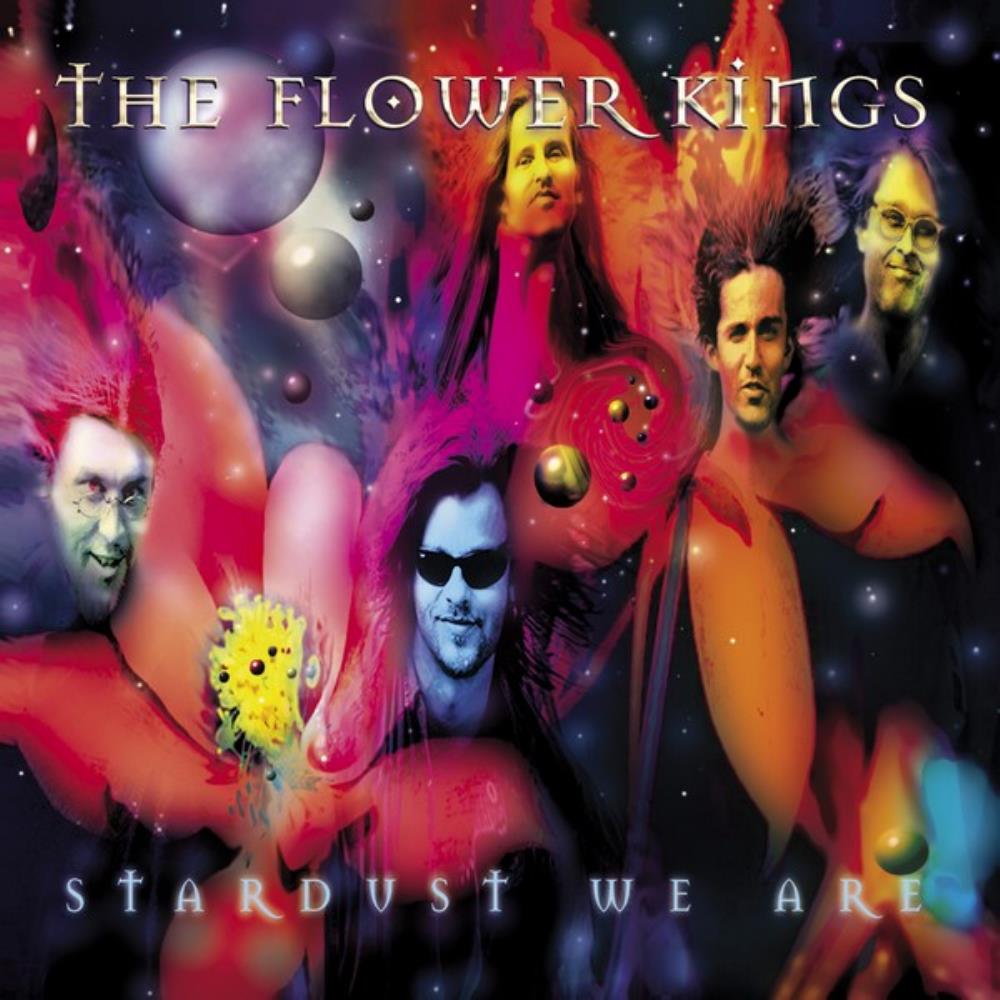
THE FLOWER KINGS Stardust We Are
The Swedish symphonic/eclectic rock Neo Proggers begin their tradition of publishing far more music than one person can possibly ingest in one sitting (or even two!) covering so many styles that it becomes far too overwhelming to enjoy as a whole. The listener has to pick and choose one's song from the enormous variety offered instead of sitting down for an enjoyable 45 minute listen.
Line-up / Musicians:
- Hasse Fröberg / lead & backing vocals
- Roine Stolt / electric & acoustic guitars, keyboards, lead vocals
- Tomas Bodin / piano, Rhodes, Hammond, Mellotron, Waldorf synth, pipe organ, Optigan, accordion, effects, co-producer & mixing
- Michael Stolt / bass
- Jaime Salazar / drums
- Hasse Bruniusson / percussion
With:
- Ulf Wallander / soprano sax
- Roine Stolt / electric & acoustic guitars, keyboards, lead vocals
- Tomas Bodin / piano, Rhodes, Hammond, Mellotron, Waldorf synth, pipe organ, Optigan, accordion, effects, co-producer & mixing
- Michael Stolt / bass
- Jaime Salazar / drums
- Hasse Bruniusson / percussion
With:
- Ulf Wallander / soprano sax
- Håkan Almkvist / sitar, tabla
CD 1 (54:34)
1. "In The Eyes Of The World" (10:38) don't like this rhythm track style at all. (16.75/20)
1. "In The Eyes Of The World" (10:38) don't like this rhythm track style at all. (16.75/20)
2. "A Room With A View" (1:26) gentle keyboard interlude. (4.25/5)
3. "Just This Once" (7:53) a more tolerable sometimes even enjoyable style and construct. (13/15)
4. "Church Of Your Heart" (9:10) nice soundscape to open with but then the vocal/lyrics push me away. (Maybe it's just Roine Stolt's voice that drives me away.) Cute homage to Rick Wakemen ("Awaken") with the use of the solo pipe organ. Nice melodies, nice "gospel"-like finish. (17.5/20)
5. "Poor Mr. Rain's Ordinary Guitar" (2:43) rainstorm with two electrified acoustic guitars. Roine is no Will Ackerman or Chet Atkins. (4.25/5)
6. "The Man Who Walked With Kings" (4:59) organ arpeggi with acoustic guitar open this song in a very classical Xmas carol feeling. A nice song, actually--even when it goes rock 'n' roll. Great lead guitar work from Roine. (9.5/10)
7. "Circus Brimstone" (12:03) another example of the fact that listening to a RFK album is like channel surfing on Cable TV. I, for one, like a little more consistency in sound, style, or instrumentation (not necessarily all three) from an album. The first 2:30 are completely into horror film soundtrack à la GOBLIN, and then we get more rock-oriented like or even UNIVERS ZERO (a little). I like the little child-friendly passage in the sixth minute, but then things ramp back up. The third fourth gets a little angular but then we return to the rock (YES) orientation and more for teh final quarter. (22.5/25)
8. "Crying Clown" (0:57) truly a circus theme. Closes out the "Brimstone" song nicely.
9. "Compassion" (Actual song length is 4:45; hidden instrumental track follows) (8:40)
- first song: weird effects (8.5/10)
- Second song is pure experimental electronica--like the beginning of Todd Rundgren's "Utopia Theme" gone rogue. (8.25/10)
CD 2 (71:41)
10. "Pipes Of Peace" (1:19) pipe organ solo. Kind of a prelude to the next song. (4.25/5)
11. "The End Of Innocence" (8:28) nice enough music led astray by the band's choice to focus on Roine's anæmic singing and lyrics. Also, the pace, while comforting at first for its ability to allow much to happen in its spaciousness, becomes tedious over its eight minute length. (Would that it's intriguing final 30 seconds had lead to something new and different.) (17/20)
CD 2 (71:41)
10. "Pipes Of Peace" (1:19) pipe organ solo. Kind of a prelude to the next song. (4.25/5)
11. "The End Of Innocence" (8:28) nice enough music led astray by the band's choice to focus on Roine's anæmic singing and lyrics. Also, the pace, while comforting at first for its ability to allow much to happen in its spaciousness, becomes tedious over its eight minute length. (Would that it's intriguing final 30 seconds had lead to something new and different.) (17/20)
12. "The Merrygoround" (8:17) trying to be YES. Too bad for the ridiculous lyrics. (17/20)
13. "Don Of The Universe" (7:02) timbales! chimes! Anthony Phillips-like acoustic 12-string guitar! sitar! Great beat and rich guitar chord progression. Almost an Ozrics sound--just a bit too slow. Great bass and saxophone. Instrumentals are where this band excel! (14.5/15)
14. "A Day At The Mall" (0:45) electronic piano from the county fair.
15. "Different People" (6:19) built around a laid back acoustic strum, it's a nice start but then why do they let this guy sing? Nice guitar solo in the middle. (8/10)
16. "Kingdom Of Lies" (5:48) I've noticed through the years that Roine and company have a little bit of an obsession with musical themes generally associated with the circus or carnival. Here, using an alternate vocalist gives the music a totally different (albeit 1980s hair band) feel. The music, once it's established, is a rather straightforward classic rock form with horse-trot bass and pacing, but it's solid, well-performed. (8.5/10)
17. "If 28" (2:15) solo piano notes played in a large, empty space. Great acoustic effect to this very pretty piece. (5/5)
18. "Ghost Of The Red Cloud" (4:37) mysteriously inviting instrumental choices are taken into another circus theme direction before taking on a kind of Rasta/Reggae rhythm flow. The slightly more impassioned vocal by Roine Stolt reminds me of Bruce Cockburn. As a matter of fact, the whole song does. (8.5/10)
19. "Hotel Nirvana" (1:49) moody synth note and small "strings" chords prep the listener for the arrival of some dramatic acoustic guitar play (two channels). Like something out of the soundtrack to a Spaghetti Western. (5/5)
20. "Stardust We Are" (25:02) one of the places TFK excells in the creation and performance of its long-playing epics. (45.5/50) = 9.1
Total Time: 126:15
My other problem with a lot of TFK music is the lack of connect to the lyrics: the words/messages are just too hoky--they work too damn hard for some kind of profundity.
88.66 on the Fishscales = B/four stars (Disc One a low four stars; Disc Two 4.5 stars--a near-masterpiece); a collection of varied symphonic prog rock music that would be an nice addition to any prog lover's music collection.
88.66 on the Fishscales = B/four stars (Disc One a low four stars; Disc Two 4.5 stars--a near-masterpiece); a collection of varied symphonic prog rock music that would be an nice addition to any prog lover's music collection.

AFTER CRYING 6
Line-up / Musicians:
- Tamás Görgényi / lead vocals
- Ferenc Torma / electric & acoustic guitars, bass, programming
- Balázs Winkler / keyboards, trumpet, percussion, programming
- Péter Pejtsik / cello, synth bass, lead vocals, programming
- Gábor Egervári / flute, spoken word
With:
- Judit Andrejszki / lead vocals
- László Koós / bass vocals
- Zoltán Lengyel / grand piano
- Pál Makovecz / trombone
- Mihály Borbély / tenor, soprano & alto saxophones
- Csaba Klenján / baritone saxophone
- Péter Erdei / horn
- Mónika Szabó / flute
- Ottó Rácz / oboe
- György Reé / clarinet
- Vilmos Horváth / bassoon
- Katalin Fenyő / violin
- Andrea Shuszter / violin
- Ágnes Herbály / violin
- Johanna Tóth-Kiss / violin
- Jutka Holló / violin
- Emese Szatmáry / violin
- Zsuzsa Beritz / violin
- Enikő Balogh / viola
- Ferenc Szekrényi / viola
- Anikó Sabján / cello
- Zsolt Puskás / cello
- Sándor Szászvárosi / cello
- Gábor Szántó / double bass
- Latinovits Zoltán / reciting voice (13)
- Ferenc Szabó / drums, percussion
- Ferenc Torma / electric & acoustic guitars, bass, programming
- Balázs Winkler / keyboards, trumpet, percussion, programming
- Péter Pejtsik / cello, synth bass, lead vocals, programming
- Gábor Egervári / flute, spoken word
With:
- Judit Andrejszki / lead vocals
- László Koós / bass vocals
- Zoltán Lengyel / grand piano
- Pál Makovecz / trombone
- Mihály Borbély / tenor, soprano & alto saxophones
- Csaba Klenján / baritone saxophone
- Péter Erdei / horn
- Mónika Szabó / flute
- Ottó Rácz / oboe
- György Reé / clarinet
- Vilmos Horváth / bassoon
- Katalin Fenyő / violin
- Andrea Shuszter / violin
- Ágnes Herbály / violin
- Johanna Tóth-Kiss / violin
- Jutka Holló / violin
- Emese Szatmáry / violin
- Zsuzsa Beritz / violin
- Enikő Balogh / viola
- Ferenc Szekrényi / viola
- Anikó Sabján / cello
- Zsolt Puskás / cello
- Sándor Szászvárosi / cello
- Gábor Szántó / double bass
- Latinovits Zoltán / reciting voice (13)
- Ferenc Szabó / drums, percussion
- I - Save Our Souls :
1. Save Our Souls (2:49)
- II - Panem Et Circenses :
2. Fun Fair Land Open (4:33)
3. Providence (Dance with the Sleep-Walker Marionettes) (2:44)
4. Salto Mortale II (Trash-Flow) (8:46)
- a) Nuclear Feast
- b) Bumper Car
- c) Ferris-Wheel
- d) Burlesque
5. Sleeping Chaplin (2:39)
6. Madrigal Love Part Four (Casanova) (4:13)
7. Final (Big Evil Fun Fair Finale) (6:26)
- III - Intermezzo :
8. Intermezzo (2:48)
- IV - Farewell To 20th Century:
9. Viaduct (4:36)
10. Salto mortale I (Helpless) (3:33)
11. Enigma II (5:41)
12. Struggle For Life (9:11):
- a) With a Pure Heart
- b) Waiting for Better Days
13. The Man and The Rock / American Express (4:56)
- V - Conclusion :
14. (Tribute to Keith Emerson) (10:45)
Total Time: 73:44
on the Fishscales = / stars;
1. Save Our Souls (2:49)
- II - Panem Et Circenses :
2. Fun Fair Land Open (4:33)
3. Providence (Dance with the Sleep-Walker Marionettes) (2:44)
4. Salto Mortale II (Trash-Flow) (8:46)
- a) Nuclear Feast
- b) Bumper Car
- c) Ferris-Wheel
- d) Burlesque
5. Sleeping Chaplin (2:39)
6. Madrigal Love Part Four (Casanova) (4:13)
7. Final (Big Evil Fun Fair Finale) (6:26)
- III - Intermezzo :
8. Intermezzo (2:48)
- IV - Farewell To 20th Century:
9. Viaduct (4:36)
10. Salto mortale I (Helpless) (3:33)
11. Enigma II (5:41)
12. Struggle For Life (9:11):
- a) With a Pure Heart
- b) Waiting for Better Days
13. The Man and The Rock / American Express (4:56)
- V - Conclusion :
14. (Tribute to Keith Emerson) (10:45)
Total Time: 73:44
on the Fishscales = / stars;
Not As Good As Advertized

10. BONDAGE FRUIT -- III
I don't get Japanese Zeuhl. I get French Zeuhl, Belgian Avant Garde, UK Rock-in-Opposition, Scandanavian Symphonic and Death Metal, Dutch Neo Prog, Krautrock and Berlin School Electronic, Polish Heavy Prog. I even think I get Rock Progressive Italiano, but I don't get Japanese Zeuhl. I understand that the Japanese are masters of imitation--that they are even capable of taking previously defined forms and elevating them in terms of precision with their virtuoso mastery of their instruments. But I don't get how Japanese bands like Happy Family, Koenji Hyakkei, Ruins, and these guys, Bondage Fruit, fit into the Zeuhl scene. I mean, is there a Japanese translation of Kobaïan? a blood/DNA connection to Egyptian king Ëmëhntëhtt-Ré? a notorized endorsement from Camp Vander?
Line-up / Musicians
- Kido Natsuki / guitar, organ, synth
- Katsui Yuji / vocals, violin, sampler, producer
- Ohtsubo Hirohiko / bass
- Takara Kuimiko / vibraphone, percussion
- Okabe Youichi / percussion, trap drum, electronics
1. "Odd-job" (11:40) opens like a ROLLING STONES sound check, sounds, pacing, rhythms, and even riffs sound as if they come straight from some Stones song(s). (It turns out that the song may have been recorded in front of a live audience anyway!) When things breakdown into quietude in the third minute, even the vibes seem to remind us that this is a "déjà vu" type of moment as he plays the famous "Twilight Zone" theme riff--which is later picked up and carried by the violinist. As far as I can tell, this is the strongest link to a structural thread that the song has (aside from the drummer's fairly faithful attention to carrying forward a beat on the "ride" or "swish" cymbal). More old 60s early blues-rock riffs are introduced and toyed with over the second half of the song with little effect in inspiring a whole-band ethic until, finally, at the end of the ninth minute, something clicks (sparked by Katsui vocalise?) and everyone starts to really jam--coherently and cohesively. It's truly magical, but really? Nine minutes of shit to get to this point? Have you ever heard of "practice"? or editing? Can't the drummer and bass player fly all-out like that all the time? (15/20)
2. "Kagee Ga Kieru" (8:18) opens with some very sensitive, melodic, and careful play from vibes, violin, electric guitar, and the occasional bass note. It's beautiful even if it does sound like a ROY BUCHANAN or JEFF BECK piece. And all band members are on the same page--playing what constitutes a loose, contrived weave. Even when drummer Okabe Youichi enters in the fifth minute he is restrained and delicate. (14/15)
3. "Shortwave From Outer Space" (2:52) is a contrived construct to fabricate exactly what the title says it is. Keys, electronics, percussives. I have to admit: it's pretty good. (5/5)
4. Frost And Fire (12:32) opens at a gallop (the drumming literally sounds/feels like a horse's hoofbeats at a running gallop). In the third minute Kido Natsuki's guitar and Katsui Yuji's violin synchronize (bass is mixed way in the background) and mirror one another in trampsing through some Fripp-McLaughlin-like scales of chromatic dissonance. In the third minute the duet becomes a duel as violin drops out and searing guitar surges forward. Very Mahavishnu-like until he starts playing chords, but mostly he's playing single-note runs at breakneck speeds. Six minutes into the song, the guitar solo stops, Kido pairs up again with the violin, until Katsui breaks free to solo over the bare-bones help of Okabe Youichi and Takara Kuimiko's percussion play. Starting out slow, even melodically, Katsui builds and shifts gears as the crazy guitar strumming and percussion play provide the impetus for what becomes an almost deranged solo. Pretty cool. (I still don't get how or why this is "Zeuhl.") The two come back together at the very end to punch and drop dead. (Crowd clapping at the end! WTF?) (8.5/10)
5. "Récit" (28:19) opens with some guitar riffs from YES's song, "Close to the Edge," played over electronic chirping bird sounds. Violin then takes the next shot, playing some Mahavishnu Orchestra-like riffs before the whole band engages in the third minute. As the title suggests, perhaps this song is merely a clever merging of the recitation of many of the most famous or impressive riffs and motifs from the "classic era" of progressive rock music. I cannot name them all, but each individual melodic riff put before the drums and Zeuhlish bass by the guitar, vibes, and/or violin seem so familiar that I feel guilty for not being able to name them immediately.
The drum work, once it has begun, remains fairly constant in its breakneck, KEITH MOON-like pace and busy-ness. The other instrumentalists have merely to play whatever they wish--and they do, now mixing separate riffs as if standing alone with the drummer, oblivious to the other band members. I suppose some might find this entertaining, even an exciting intellectual challenge (to solve the "name that tune" mystery puzzle pieces), but I am not of this group. The test for me would be to see the band "recite" this song in full replication in a live setting. (Much of it seems as if it could have been improvised and would, therefore, be quite difficult to replicate. Ever.)
Somewhere in the twelfth minute the sound engineer is suddenly called out of the sound booth. Seeing no reason to continue, the band drop their instruments and head off to the lunch room, Thus, around the 13:00 mark we, the listener, are treated to a spacious reprieve as all band members walk out of the studio for their lunch break leaving only vibes player Takara Kuimiko alone with the admonishment, "You need to practice!"
After their bento boxes have been emptied, guitarist Kido Natsuki and violinist Katsui Yuji return to tune their instruments while bassist Ohtsubo Hirohiko takes extra time to get out his double bass--which he, likewise, has to tune. All of this, of course, is still being recorded as the sound engineer had to go get take out and forgot to push "pause" on the console. Drummer Okabe Youichi has to eat twice as much as the others as he is expending many more calories than the others, but eventually, in the eighteenth minute, he, too, returns and begins tuning and adjusting his instrument. Somewhere in the twenty-first minute the engineer returns so the band members start to jam just to let him thing that they've been working hard. The odd thing is--and this really surprises the band--is this time it really works! The whole "Close to the Edge" riff jam thing finally comes together into an interactive, full-band explosion. But, then, after about five minutes of that, the band has had enough and try to shut it down, but, as most musicians are rather hard-headed, they can't decide who gets to have the last word so they're all left there standing as the feedback from the amps and monitors slowly decay and fade.
6. Kinzoku No Taiji (Live *) (8:39) opens as the whole band, Takara Kuimiko on vibes, bursts into form and function. Bass lines from Ohtsubo Hirohiko are flowing like machine gun fire, the violin sounds as if it's going to start smoking, while Kido Natsuki restrains himself (as long as he can) to wild flailing chord play. After five minutes of "holding space" for others, he can no longer restrain himself, joins the fray of soloists, gradually pushing Katsui Yuji out of the soundscape (he tries to re-approach several times but is thwarted each time--the third time by the vibes!) Now, this, might qualify as Zeuhl--though Mahavishnu Jazz Fusion is more like how I'd describe it. Special shout out: Well done, drummer Okabe Youichi! (20/20)
* Recorded at Shinjuku Pitinn on 25 Feb. 1997
Total time 72:20
82.69 on the Fishscales = B-/3.5 stars; an unusual album of Mahavishnu Orchestra-like jazz fusion. The songs often have trouble coming together--seemed improvised--as might give reason to doubt the truth that this was released under the auspices of being a studio album when all but two of the songs have audience clapping at the end.

IQ Subterreanea
- Peter Nicholls / lead & backing vocals
- Mike Holmes / guitars, guitar-synth, addit. keyboards (?), producer
- Martin Orford / keyboards, backing vocals
- John Jowitt / basses, bass pedals (?), backing vocals
- Paul Cook / drums, percussion
With:
-Tony Wright / sax
CD 1
1. "Overture" (4:38) mimicking the warmup and opening of an orchestra before crashing into a slow-steady prog rock. As intimated by the title, there are several melodic themes presented here that will be repeated later in individual songs, so this is, in fact, a true overture. (/10)
2. "Provider" (1:36)
3. "Subterranea" (5:53)
4. "Sleepless Incidental" (6:23)
5. "Failsafe" (8:57)
6. "Speak My Name" (3:34)
7. "Tunnel Vision" (7:24)
8. "Infernal Chorus" (5:09)
9. "King Of Fools" (2:02)
10. "The Sense In Sanity" (4:47)
11. "State Of Mine" (1:59)
Total Time: 52:22
CD 2
1. "Laid Low" (1:29)
2. "Breathtaker" (6:04)
3. "Capricorn" (5:16)
4. "The Other Side" (2:22)
5. "Unsolid Ground" (5:04)
6. "Somewhere In Time" (7:11)
7. "High Waters" (2:43)
8. "The Narrow Margin" (20:00) (34.75/40)
Total Time: 50:09
Albums on the Fringe of Prog World

RADIOHEAD OK Computer
The universally-praised 1997 release from the creators of the international mega-hit, "Creep", critics and the general public were quick to take notice of the huge leap in confidence and maturity that the band had achieved with OK Computer. It's still guitar-based but in a heavily-treated (using a lot of "natural reverb" ambient to the castle in which it was recorded), woven, texturalized way that surprised many who saw the band as potential generators of an endless parade of introspective pop hits. I, personally, like it okay (no pun intended) but, I say, just wait till the next one! (Kid A)
A very good 4.5 star album that has issues for we mere mortal listeners with access, penetrability, and long-term engagement. Despite these "flaws," it is an album that gives back over time far more than the usual album. Many of the album's songs have consistently grown on me over the years).


